



November 11, 2026
By David Sloan Wilson, Dennis J. Snower, Robert Kadar, and Steve Roth
In the 1990s, geneticist William Muir ran a remarkable experiment with chickens. His findings contain a lesson that economists would do well to consider.
Muir wanted to breed hens that laid more eggs. Hens live in groups, whether free range flocks or cages. The conventional approach seemed obvious: identify the most productive egg-layers within each group, breed them, and repeat. Over generations, the result should be more productive groups composed of superior individuals. What could go wrong?
Plenty. The procedure selected the biggest bullies, who achieved their productivity at the expense of their groupmates. Bullying is a genetically heritable trait, and several generations of selection resulted in a strain of psychopaths, who plucked each other’s feathers and murdered each other in their crusades to become #1. Egg productivity plummeted, even though the “best” hens were selected in every generation.
In a second experiment, Muir monitored egg productivity at the level of groups and selected all the hens from the most productive groups to breed the next generation of hens. This procedure resulted in a dramatic decline in mortality and increase in egg laying productivity.
The great error of the first experiment was to suppose that what can be measured in an individual is a property of the individual. If the best hens within each group were simply the best physiological egg-layers, selecting them would have made sense.
But the reality was different: What could be measured in an individual was also a property of its social interactions with other individuals. That’s why the second experiment worked so well. Competition still took place, but it selected the best social interactions.
The Fallacy of the Invisible Hand
What’s this got to do with economics? Consider the common corporate practice of forced distribution ranking, often called “rank and yank.” Employees are ranked for their individual performance. The best are rewarded, the middle range is coached, and the worst are let go. What could go wrong?
Plenty. The similarity of “rank and yank” with the first chicken experiment is unmistakable. Genetic evolution does not take place, but something similar does that results in the same outcome. The biggest bullies in the organization are retained; the incentives discourage cooperation and bring out the bully in everyone. One review of the evidence concluded that “We can find plenty of consultants and gurus who praise the power of dispersed pay, but we can’t find a careful study that supports its value in settings where cooperation, coordination, and information sharing are crucial to performance.”
The failure of extreme “individual-chicken” selection in the business world may be best illustrated by the collapse of Sears, a long-storied American institution. In 2013 Edward Lampert, an outspoken Ayn Rand devotée, became CEO and reorganized the company’s divisions into 30 competing, independent businesses with their own (competing) CEOs who were evaluated only on their own divisions’ financial performance. Within years, you could no longer buy Craftsman tools, Kenmore appliances, or DieHard batteries at Sears stores. In 2018 the company filed for bankruptcy. Five stores remain today.
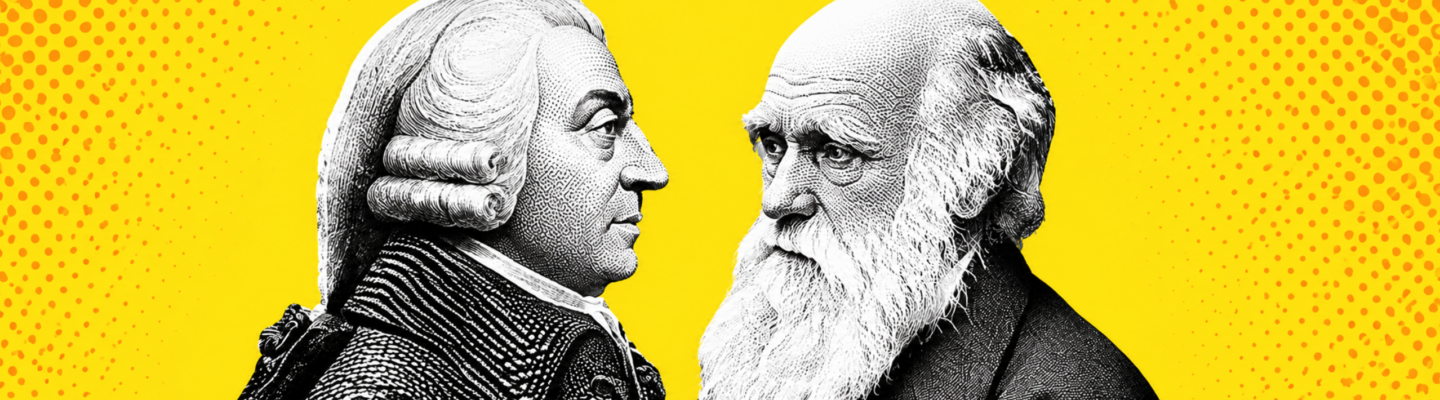
Examples comparable to “rank and yank” and Lampert’s epic failure are everywhere, in part because they appear justified by Adam Smith’s metaphor of the invisible hand, which assumes that the pursuit of lower-level interests robustly benefits the common good. This metaphor does not represent the full scope of Adam Smith’s thought in his two great books — The Theory of Moral Sentiments (1759) and The Wealth of Nations (1776) — but it does represent the heart of modern neoclassical economic theory, which does a poor job of distinguishing between inefficiencies and negative externalities arising from marketing competition itself, as opposed to those arising from the level of competition. Shockingly, we have been misled by our ideas to create an economic system comparable to the first chicken experiment.
Darwin’s Visible Hand
A new set of ideas is called for that avoids the blinkered view of the invisible hand. We are calling it Darwin’s visible hand, and it consists of two primary insights.
First, there is more to Darwinian evolution than genetic evolution. As a word in the English language, evolution refers to any kind of gradual change. Darwin (along with Alfred Russell Wallace) gave the word a more specific meaning: a process that combines the ingredients of variation, selection, and replication (VSR), resulting in the evolving agents adapting to their environments. In addition to genetic evolution, VSR processes include the open-ended learning ability of individuals, human cultural evolution, and most recently the AI revolution. While this list might seem daunting, there is a take-home message that can be easily understood: whenever a VSR process operates, the properties of the evolving agents–whether human or nonhuman, individuals or groups, or AI agents–are shaped by their environments. And to a great extent, the environment inhabited by humans is of our own construction.
We have already seen this in our comparison of the first chicken experiment and “rank and yank.” In both cases, the environment favored bullying behavior. The fact that the VSR process was genetic evolution in the case of the chickens, compared to cultural evolution and individual behavioral flexibility in the case of “rank and yank,” was a detail. Part of the power of Darwin’s visible hand is to make predictions based on the shaping influence of the environment, without needing to know much about the mechanisms underlying the VSR process (although mechanistic understanding is also very useful).
The second primary insight is that competition is not an unalloyed good. Lower-level selection tends to be disruptive at higher scales. Self-preservation becomes self-dealing. Helping kith and kin becomes cronyism and nepotism. “My nation first” becomes international conflict. Growing our economies becomes overheating the earth. In general, if we want our whole systems to function well, we must select at the level of whole systems. The second chicken experiment is a vivid example of this more general rule. In this multi-level view, competition is only valuable to the extent that it promotes cooperation — the special cultural trait that elevated homo sapiens to the top of the global food chain.
Markets Are Selection Environments
The general import of Darwin’s invisible hand for economics is that markets are not merely allocation mechanisms. They are also selection environments—a point neoclassical economists recognize but often fail to appreciate fully: that competition can produce either productive or pathological outcomes, depending on how it is structured.
The implications extend far beyond the hiring practices of individual companies. Suppose acquiring competitors becomes more profitable than developing new products. Firms that consolidate may outperform those that innovate. Investors reward the consolidators, and other companies follow. Eventually, an industry may become dominated by businesses whose profitability depends increasingly on market power rather than productive excellence. No conspiracy is necessary. Competition has rewarded consolidation, and consolidation has spread.
What economists often treat as a market failure can also be understood as an evolutionary process — one that shapes the future structure of the economy. The entire shareholder value model advocated by Milton Friedman in the 1970’s is a version of the first chicken experiment, shaping companies to maximize short-term profits for a narrow subset of people without regard to negative externalities for society as a whole.
A Parade of Nobel Laureates
Once we make a clear distinction between Adam Smith’s invisible hand (the claim that lower-level competition robustly benefits the common good) and Darwin’s visible hand (the claim that the level of competition matters), we can see that great thinkers in the history of economics have been reaching in the direction of Darwin’s visible hand, without necessarily mentioning Darwin by name. Some of these received the profession’s highest honor, once the Nobel Prize in Economics was established in 1968. Earlier figures include Thorstein Veblen–who famously asked the question “Why is economics not an evolutionary science?” in 1898, and Joseph Schumpeter’s concept of creative destruction in 1942.
Friedrich Hayek (1974 laureate) pioneered the concept of economic systems as products of multilevel cultural evolution, in opposition to Milton Friedman’s rational actor and equilibrium theory (example: Competition as a Discovery Procedure). Like Adam Smith, Hayek was far more nuanced than the market fundamentalism that most people attribute to him.
Herbert Simon (1978 laureate) famously critiqued neoclassical economics, which he called the “Olympian model,” in favor of a more limited view of “bounded” rationality operating in the context of culturally evolved institutions. Simon understood that Darwinian evolution goes beyond genetic evolution when he wrote “Notice that this way of viewing artifacts applies equally well to many things that are not man-made–to all things in fact that can be regarded as adapted to some situation, and in particular it applies to the living systems that have evolved through the forces of organic evolution”.
James Buchanan (1986 laureate), a founder of public choice economics, had a fine sense of how lower-level entities inside and outside government evolve in ways that do not benefit the common good. He coined the term “symbiotics” as the study of the association between dissimilar organisms, where the core connotation is that the interaction must be mutually beneficial to all parties.
George Akerlof (1991 laureate) demonstrated how markets can reward behavior that ultimately undermines the market itself. In his famous paper The Market for Lemons, Akerlof showed how information asymmetries between buyers and sellers (sellers generally have more information) can cause low-quality products to drive high-quality products out of a market. From an evolutionary perspective, the market is selecting against quality rather than rewarding it. In his later work with economist Rachel Kranton on Identity Economics, Akerlof further challenged conventional economic thinking by demonstrating how social identities and norms, not just financial incentives, shape economic behavior and cooperation.
Joseph Stiglitz (1991 laureate) extended our understanding of how imperfect information can undermine market efficiency. His research demonstrated that markets with information asymmetries need not produce efficient outcomes. The financial crisis of 2008 illustrated how institutions could profit by originating, packaging, and distributing risky mortgage securities while imposing systemic risks on the broader economy. In his later work with economist Karla Hoff, Stiglitz further challenged conventional economic thinking by demonstrating how social norms, cultural beliefs, and institutions shape not only the incentives people face, but also their preferences, perceptions, and economic behavior.
Elinor Ostrom (2009 laureate) addressed the quintessential problem of lower-level competition undermining the common good known as the tragedy of the commons. She showed that groups can avoid the tragedy of the commons by adopting certain core design principles and that multi-group ecosystems can become coordinated by what she called polycentric governance (similar to Buchanan’s symbiotics). Later work has demonstrated that her insights for common-pool resource groups can apply to all cooperative endeavors.
Daron Acemoglu (2024 laureate) has shown how institutions shape long-term prosperity. Inclusive institutions can support broad participation, investment, and innovation, while extractive institutions concentrate power and enable elites to appropriate wealth. From an evolutionary perspective, institutions influence which strategies succeed. Where productive entrepreneurship offers the greatest rewards, innovation may flourish. Where political connections determine economic opportunity, cultivating powerful patrons may become more profitable than developing better products. In his work with economists David Autor and Simon Johnson, Acemoglu extends this insight to artificial intelligence, arguing that market incentives can favor technologies that replace workers over those that enhance human capabilities, even when the latter could generate greater benefits for society.
Joel Mokyr (2025 laureate) demonstrated that sustained economic growth depends on more than individual inventions or market competition. It requires the accumulation and exchange of useful knowledge, institutions that allow new ideas to challenge established interests, and a culture that encourages experimentation and innovation. From an evolutionary perspective, prosperity emerges when societies create environments in which productive knowledge, technologies, and practices can develop, spread, and build upon one another. Markets can help select successful innovations, but the broader institutional and cultural environment determines whether that process generates sustained progress. In his work on the Industrial Enlightenment and the Republic of Letters, Mokyr further demonstrated how networks of scholars, inventors, and entrepreneurs created a culture of open inquiry and knowledge-sharing that helped make sustained technological progress possible.
These are among the most celebrated economists in the world, but the common thread that unites their work is not sufficiently appreciated. They all reject the notion that the pursuit of lower-level interests robustly benefits the higher-level common good (the received and reduced version of Adam Smith’s invisible hand), and embrace the need to evolve economic systems as whole systems (Darwin’s visible hand). Multilevel selection theory provides a disciplined theoretical framework for accomplishing this systemic goal.
Toward a New Economic Paradigm
A new generation of thinkers is beginning to put the pieces together. Eric Beinhocker was among the first to identify evolutionary science and complex systems science as “the radical remaking of economics” in his 2006 book The Origin of Wealth. More recently, Beinhocker and political scientist Jenna Bednar have argued for the paradigmatic status of what we are calling Darwin’s visible hand–an interlocking set of ideas that make sense of the world in ways that are invisible to the neoclassical economic paradigm.
Beinhocker has also joined entrepreneur Nick Hanauer in translating these insights into a broader vision for capitalism. Their 2026 booklet, Markets Built for Humans, introduces a framework they call Market Humanism. It begins with a different understanding of economic purpose: prosperity comes from solving human problems through cooperation, innovation, and the accumulation of knowledge. Markets create value by fostering competition among solutions, while governments and other institutions help establish the conditions under which productive cooperation can flourish.
This represents an important shift in how we understand markets, reinforcing our central claim that competition is not an end in itself, nor does it only produce outcomes that benefit society. Its value depends on what it rewards and selects. When competition encourages innovation and cooperation, it can generate extraordinary prosperity. But when it rewards extraction, exclusion, or the destruction of shared resources, the same competitive process can undermine the prosperity it is supposed to create.
The question, then, is no longer simply whether markets should be more or less competitive. It is what kinds of behaviors competition rewards in a given social, cultural, economic, and political context, and whether those behaviors contribute to the success of the larger economy.
Get Evonomics in your inbox
Exploring the Implications of Darwin’s Visible Hand
This article introduces Darwin’s visible hand as a paradigmatic alternative to the notion that lower-level competition and selection reliably benefits the common good. Subsequent essays by ourselves and others will explore the implications for economics, artificial intelligence, and indeed all positive change efforts as the intentionally guided evolution of living systems. Just as the metaphor of the invisible hand has misled us into creating a world like the first chicken experiment, the metaphor of Darwin’s visible hand can lead us to create a world like the second chicken experiment.
Donating = Changing Economics. And Changing the World.
Evonomics is free, it’s a labor of love, and it's an expense. We spend hundreds of hours and lots of dollars each month creating, curating, and promoting content that drives the next evolution of economics. If you're like us — if you think there’s a key leverage point here for making the world a better place — please consider donating. We’ll use your donation to deliver even more game-changing content, and to spread the word about that content to influential thinkers far and wide.
MONTHLY DONATION
$3 / month
$7 / month
$10 / month
$25 / month
You can also become a one-time patron with a single donation in any amount.
If you liked this article, you'll also like these other Evonomics articles...



BE INVOLVED
We welcome you to take part in the next evolution of economics. Sign up now to be kept in the loop!

